Products | Innovations | Design Enthusiast | Passionate VFX and Video Creator |
Author: Kunal Jauhari
Kunal Jauhari is a talented, multi-faceted, efficient & reliable Product Manager with over a decade years of work experience and rich background in technology. He believes, "Taking risks in life, If we win, we can lead, but if we lose we can guide". He also thinks mindfulness in the workplace is key to success - a tenet he lives out through her interests in IoT, VFX, Gardening, and Running.
Provide consumers the best and create a hassle-free cooking experience at home
A way for Swiggy to access high margin new revenue availing of investments already made and risks already taken
•Highly profitable: because this strategy will be leveraging Swiggy’s foundational assets they already have in their core
•Lower Risk: because their ability to operationalize is quicker than launching a new business
•Higher probability of success: because the increase in complexity to execute is marginal relative to further afield opportunities
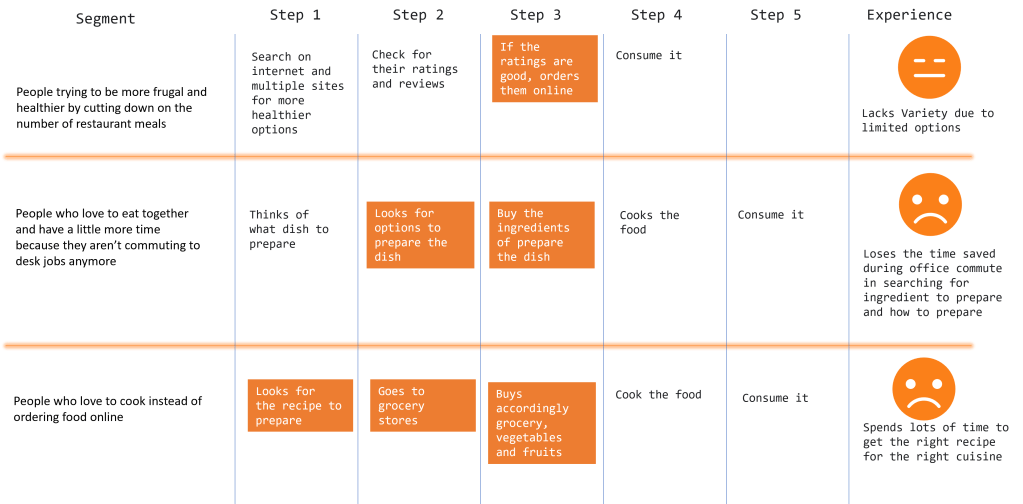
CUSTOMER SEGMENTATION & MISSION DEFINITION
CUSTOMER SEGMENTATION & MISSION DEFINITION
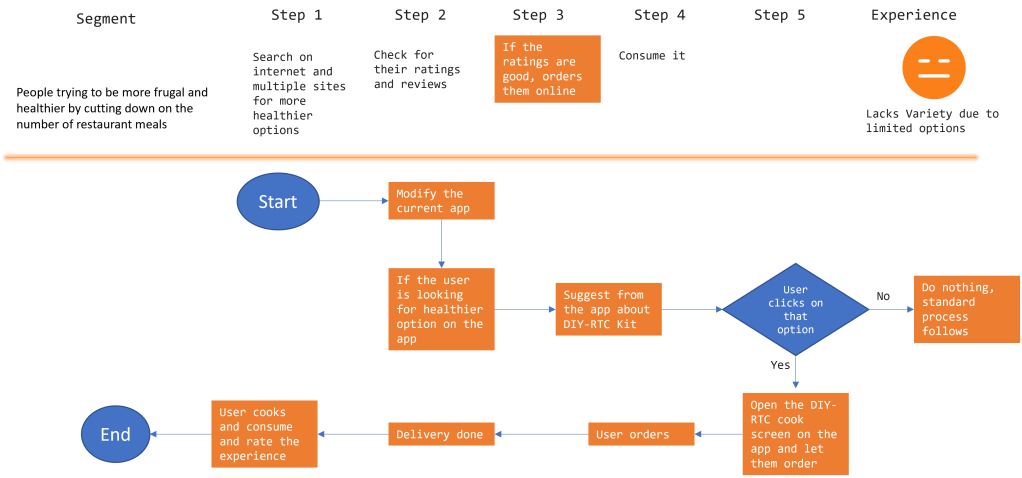
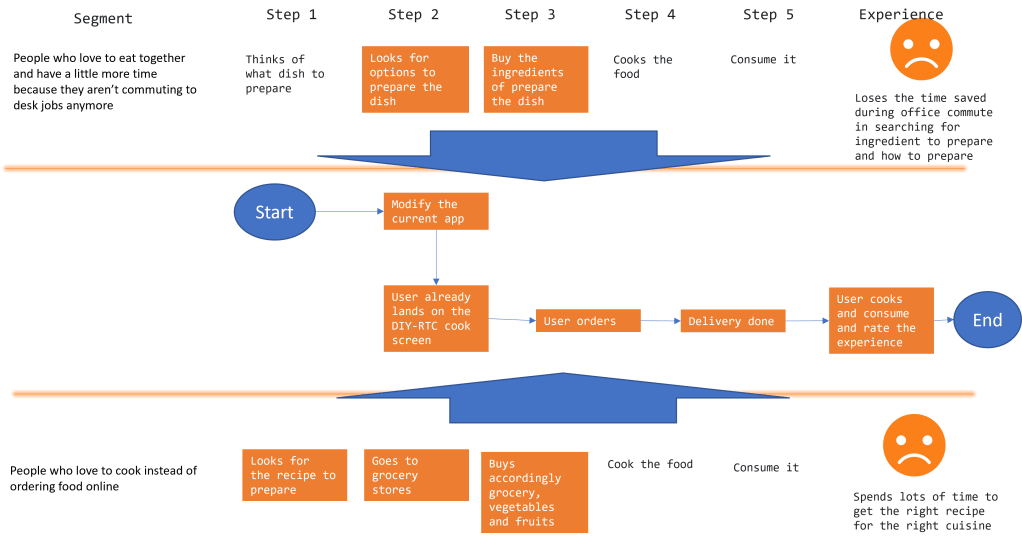
JOURNEY MAPPING
PERMISSION TESTING
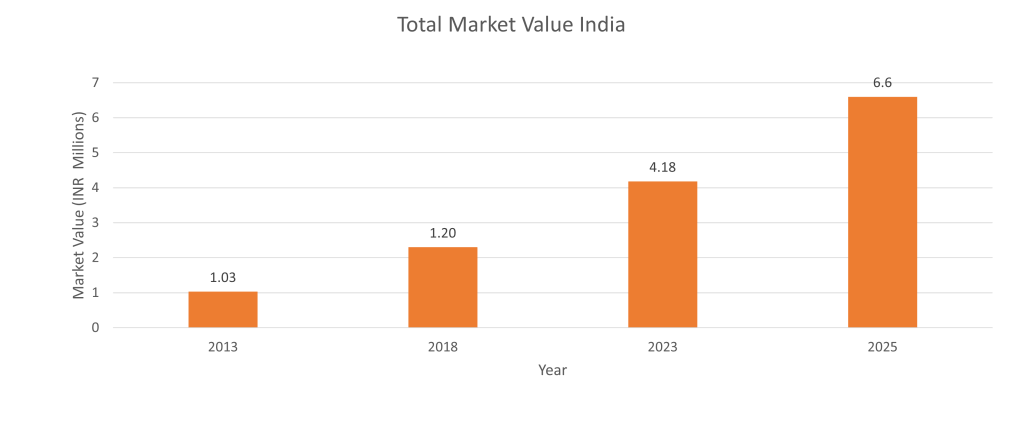
BUSINESS MODEL FORMULATION & HYPOTHESIS TESTING
Finally to sum it up
Everyone is looking for an edge, or advantage, in business. How do we win? How do we get ahead? What is the angle that will drive our company’s success? But an edge is not just a term for advantage itself; it can also be the place where you can fi nd that advantage.
It doesn’t make a difference in what phase of work and life you’re in, you ought to learn constantly.
It doesn’t make a difference in what phase of work and life you’re in, you ought to learn constantly. There are numerous approaches to discover success, yet regardless of what way you take, it’s crucial to consistently continue learning. To remain applicable, eager, and propelled, it’s critical to make a long-lasting promise to education and growth. Developing your fundamental abilities and vocation aptitudes are so significant in light of the fact that putting resources into not just stimulates your creativity, it makes you additionally intriguing around the supper table.
This doesn’t really imply that you have to return to graduate school or seek after conventional training, yet it implies that you have to keep gaining from others, by means of different types of media and your general surroundings.
Also, I genuinely accept that on the off chance that you are hoping to invest in something that will bring about an extraordinary return, you should begin with yourself. It will be the best thing you actually do! Presently, the superb thing about investing in yourself is that it doesn’t generally need to be profession driven. Below are my thoughts on some of the primary reasons why I never stop learning:
It helps me become more Creative:
“Creativity doesn’t wait for that perfect moment. It fashions its own perfect moments out of ordinary ones.” — Bruce Garrabrandt
With regards to investing in myself, this tip is my outright top pick. I esteem creativity highly, especially what I can do to feel more imaginative, how it makes me feel spurred and inspired, and how it helps me to beat barriers
Investing in my creativity also clears my psyche and makes me more present, you know, those ‘living in the moment’ vibes. What’s more, the best news is that it doesn’t make a difference if we’re a bookkeeper, a student, a craftsman, or a visual designer, we as a whole profit from investing in our creativity.
“Creativity is intelligence having fun” — My IoT Lab
We simply need to know-how. Also fortunate for us, it’s so simple. All we need to do is find a creative outlet that suits us. For me, it’s learning new technologies, innovations, and VFXing(VFX Designing). For you, it could be cooking, painting, photography, or even gardening. Presently, the delightful thing about investing in our creativity is that we become familiar with some new aptitudes, we feel refreshed, re-energized and are ready to take on the world!
2. It helps me in my Daily Work
“Concentrate all your thoughts upon the work in hand. The sun’s rays do not burn until brought to a focus.“ – Alexander Graham Bell
Toward the day’s end, we as a whole need to accomplish the work. Furthermore, some of the time, those frauds sentiments spring up and we start to feel like an imposter, and not certain about the work we are doing.
Also, normally, this is when our self-doubt reappears. It’s the most exceedingly terrible feeling, trust me! It was really also something that has as of late, been affecting me, maybe because of this pandemic or maybe because of the so-called new norm- “Work from home”.
Along these lines, I have perceived that I have to start investing in my work by going to such workshops and events which helps me improve and emerge stronger. We would all be able to stall out in our jobs, regardless of whether we work for ourselves or another person, so the most ideal way you can invest into our work is to discover a workshop, a course(online/offline) or such events, where you would skill-up and become familiar with subjects you are lacking for growth(can be technology, communication, management etc).
I sometimes feel blessed to have friends, who have been pretty supportive and suggested me some good institute to enhance my work skills, this is the time when I came to know about the Institute of Product Leadership, a place where technology practitioners and industry leaders come together and share a common drive for creating disruptions in the product management landscape.
Also, why not check whether your Boss (if you have one)? He would be glad to pay for you to go to a workshop or a course or any such event. If it’s really work-related, your Boss should be bending over backward to help you invest in yourself, and your work. I am lucky to have a boss who supported me and guided me.
3. It helps me improve my Health
“The cheerful mind perseveres, and the strong mind hews its way through a thousand difficulties”. — Swami Vivekananda
Regularly or not we are so busy investing in our careers that we neglect to invest in our wellbeing! This is something, I perceived myself five years prior, and have since been dedicated to my health like never before. I reduced my salt and sugar intake, I have removed deep-fried meal from my menu, as it was causing me to feel very sluggish and bloated, and I have also reduced eating outside. I started running and doing some physical activities.
These are all decisions I made that are personal to my situation and because I invested in running it also helped me out with reduced body fat and, my health has never been better.
“The miracle isn’t that I finished. The miracle is that I had the courage to start.” — John Bingham
So how might you invest in your well-being? Simple. Take every day strolls. Hop into the pool two or three times each week — regardless of how cool it is brrrrr. Eat well 75% of the time. I guarantee, by causing little changes you will feel amazing and have a lot more vitality!
4. It helps me invest in my Spare Time
“Teaching kids to count is fine but teaching them what count is best “— Bob Talbert
Before the COVID-era (grrrr feels like its been a decade), my spare time was never been more precious, and I think that is because I was a part-time teacher. In my spare time, which I always used to find some way or the other, I have been investing in teaching kids of regional government schools, in Bangalore. I had to slightly learn “Kannada (local language)” and the rest was manageable as our new generation is smarter than we think.
It’s public and everywhere, India houses 430 million youngsters in the age gathering of 0–18 years with an extensive number of students residing in rural areas. The status of education in the rural towns of India is miserable, obviously. Even though many kids attend schools, they remain ill-equipped.
Education is our passport to the future, for tomorrow belongs to the people who prepare for it today. I am not a teacher, but an awaken-er.
There are many reasons for failure. First and foremost, there is a huge shortage of teachers. There is also longstanding disregard, inadequate public financing and responsibility, and absence of inspiration among some teachers to pay special attention to helpless kids from lower standings. Indeed, even essential amenities like water and power are not being given.
This was a catalyst for me, to start helping them in my spare time. In the end, they also deserve their very needed dose of education, even though our government has failed miserably. Also at the end of the day, when you go to bed, that feeling of accomplishment keeps you motivated for another day.
So in short, plan if you need to, set time aside, to do all the things you love. You won’t regret it. Also, don’t occupy your extra time with tonnes of exercise. It’s absolutely alright to unwind and enjoy a Netflix gorge on the sofa with some popcorn.
Just Remember — Great leaders are great learners, and as leaders, it’s also important to share what you learn. While it’s important for you to have followers, it’s critical for you to develop other leaders. Leaders who develop leaders invest time in sharing what they’ve learned with others. By doing so, you also model the importance of continuing to learn and grow. Learning and sharing what you learn to develop other leaders is how you make an impact and leave a legacy.
“Anyone who stops learning is old, whether at twenty or eighty. Anyone who keeps learning stays young”
So to sum it up, many of us make the mistake of thinking they have all the answers and stop learning whereas there is no such age or time to stop it. Successful leaders never stop learning. Learning requires keeping an open mind, listening, and exploring, and I just provided you with four different reasons which will keep you going. So “Never stop learning”.
In this digital age, Integration is becoming the top priority for organizations. Customers are now asking for a very well connected digital experience across all their engagements, whereas businesses don’t even want to lose the opportunity of collaborating with partners and co-innovating with customers within their network. Digital integration is becoming the new norm of collaboration. This opens up the doors for organizations to turn into Intelligent Enterprises.
SAP’s Intelligent Enterprise suite strategy’s cornerstone is Integration. SAP Cloud Platform Integration Suite is SAP’s enterprise-level integration platform as a service (iPaaS) which simplifies and speeds up enterprise integration and helps organizations rapidly transition to Intelligent Enterprises. It basically talks about four various aspects of integration scenarios.
Out-of-the-box Integration
Open Integration
Holistic Integration
AI-Driven Integration
SAP Cloud Platform Integration Suite is a portfolio of Tools and Services, which are available on SAP Cloud Platform and individually tackle different aspects of Integrations.
Over the time the LoB’s leaders from HR, Finance, Sales, and Procurement went ahead and deployed ready to run, best in class applications to move faster and be on top of the game always. This approach resulted in having multiple silos, where none of these silos were integrated with each other.
The data and processes spread across multiple apps obstructed the 360-degree view of the entire business, its customers, partners, employees, and other stakeholders. This started posing a bigger problem because no one has end to end view of any scenario, any use case and it became very hard to make decisions and overall picture of how things are progressing.
SAP Cloud Platform Integration comes very handily here as it builds the bridge between these silos. It provides a foundation to apply intelligence, create the connected digital experience, and enable digital interactions and which the customers have always been looking for.
To help organizations, The mission set is to simplify the integration and lower the cost of development ownership, thereby increasing agility, improving customer experience, and collaborating in real-time to achieve process excellence.
SAP Cloud Platform Integration Suite is a one-stop solution for all the integration-related use-cases.
SAP Cloud Platform Integration Suite can simplify the integration need and is SAP’s open, modular, and Intelligent Integration Platform as a service. (iPaas).
SAP Cloud Platform Integration supports all traditional and modern integration tactics, including the following:
Application-to-application (A2A) Integration: Organizations can leverage this scenario in order to support & integrate their end-to-end processes such as Lead-to-cash, Procure-to-pay, and Hire-to-retire. This scenario also supports organizations, across all their cloud and on-premise systems, and even across SAP and non-SAP systems. SAP CPI suite puts on the table more than 150 open connectors and pre-packaged integrations, to their hubs such as ERP, Sales, Marketing, Campaigning, Socializing, Document Management, and many more.
Business-to-business (B2B) Integration: Organizations would love to make use of this scenario as it supports not only old-fashioned Electronic Data Interchange (EDI) whereas it also brings Real-time, API-based integrations which can facilitate the B2B partnerships and make it even stronger. SAP CPI suite also supports the organizations with evolving setups using Blockchain to foster trustful associations in their business network.
Business-to-government (B2G) Integration: This is also a great scenario that supports the organizations to make electronic interaction between businesses and their government agencies. Goods and Services Tax (GST) in India, Electronic Value-Added tax (e-VAT) in Spain, Pan-European Public Procurement Online (PEPPOL) across the European Union, and many more such projects are driving the e-government initiatives to perform digital interactions between businesses and government. SAP Cloud Platform Integration Suite offers pre-packaged integrations to help organizations obey the regulations and help governments bring more transparency and thereby improving the governance.
SAP Cloud Platform Integration Suite can enable real-time digital interactions which in-turn improve the business velocity and caters the need for collaboration with the customers, partners, suppliers, and vendors.
Omni-Channel Integration: Leveraging this scenario the organizations can really support the Omni-channel access and also intensely improve the customer experiences. Organizations are making use of the real-time API based integration to create Omni-channel access and hide the complexity of underlying mixed landscapes.
Digital Processes and Apps: With the help of APIs organizations can build their own apps and digitize them. This scenario helps them organizations to make use of workflows and the automated business rules using which they can build process-based digital applications and thereby integrating data silos while also creating a unified experience for their customers, employees, and partners.
Event-driven integration: This scenario supports the decoupled integrations with various applications, people, and the Internet of Things, thereby converging the sense-and-respond arrays, with serverless function as a service and enterprise messaging. Organizations can sense different events that are happening in different parts of their organizations and able to respond to those events.
Ecosystems and marketplaces: Organizations now days are heavily focussing on using open APIs to integrate into marketplaces. They are ruling business partnerships for organizations, and customers. With the help of the SAP CPI suite, this scenario enables organizations and their customers to build eco-systems via digital channels and create fresh revenue streams by monetizing APIs.
Agile Data Grids and Microservices: Organizations can also make use of a real-time access layer to protect the heterogeneous transactions and back end systems, using in-memory data grids and leveraging microservices-based architectures. They can definitely make use of DIH (Digital Integration Hub). The in-memory data grid brings data from multiple sources and puts it HANA which can later be it is exposed as APIs developed as microservices.
SAP Cloud Platform Integration Suite also creates a simplified connected experience which also leads to higher customer engagements.
To summarize, organizations can fast-track their digital journey using SAP Cloud Platform Integration Suite. In this digital era, it’s important for any intelligent enterprise to exploit this versatile, dynamic, and enterprise-grade integration platform SAP Cloud Platform Integration Suite helps the organizations to accelerate their path towards an intelligent enterprise by making integrations simpler.
Whether you are already in a role of a product manager or even thinking about a job in product management, one thing is fixed and pretty common: you will always hear different definitions of a product manager, from anyone you ask.
It’s been always confusing to understand what product manager does on a daily basis? Is the product manager really a “CEO of the product”, is he the person who manages the product or both? Well defining a product manager as “CEO of the product” is broad and misunderstood whereas defining as a person who manages the product is a much narrower view of product management.
The exact definition may vary based on number of factors and also heavily depends on which industry or company is asking. Major differences exist between the responsibilities of a product manager and the way they do business in a large enterprise, and what a product manager needs to do when working in a start-up.
After doing a lot of research and experiencing working in both environments, alongside many industry leaders and experts, who have spent half of their lives in doing and campaigning product management, I came to conclusion that we should stop trying to create a standard definition of the product manager’s role and instead spell out the various roles and responsibilities a product manager must habitually play in a dynamic environment and write down the roles that this person should undertake in technology companies both large and small step by step.
The Role & Responsibilities
Extraordinary products are the lifeline of every tech-company, whether young or mature. Product managers can have a remarkable impact on a technology company’s ability to develop great products.
The role of a product manager is really challenging and very complex. An effective product manager is an entrepreneur, tactician, technical visionary, cross-functional team leader, customer and end user advocate, all rolled into one. In short, their primary role is to define the customer experience.
Where Product Manager Fits?
Product Manager is a communication hub, he talks to various stakeholders, users receiving the feedback and working at the metrics; he many a times acts as an enabler, to review what can be built and which is the most important feature, and in many cases he acts as blocker, e.g. stopping sales team to reach out to the team directly.
A product manager has two primary responsibilities:
Defining a product to be built, and
Managing its development, launch, and ongoing improvement.
To accomplish these responsibilities, a product manager leads a cross-functional team. Ideally none of the team members report directly to the product manager, hence it is correct to say that a product manager has substantial responsibility and not much formal authority.
A product manager’s domain will be dependent on the nature of her /his company’s product line. Many product managers are solely responsible for a single product. However, some product managers oversee one of several components of a complex product (e.g., algorithms to learn without human assistance which collects data that informs the machine learning engine, behind the scenes and refreshes it for Netflix). Others manage a set of correlated products that share common components or customers (e.g., Olx’s offerings for online merchants). Product manager may also be responsible for strategic initiatives that cut across multiple products, for example, improving growth, customer retention or expanding internationally.
Types of Product Managers
Product managers are broadly classified into 3 main categories:
Internal Product Managers: These Product Managers are sometimes part of a team called Internal Tools, or something like that. They and their teams usually build tools for other people in their company organization. They build these tools for use internally as opposed to building for some general user or customer out in the public. A really good example of an Internal Product Manager is one that works with their team to build a piece of software that says the company’s support team uses to reset passwords or change account information for users. The stakeholder is someone internally. It’s the person that’s using that piece of software.
Business to Consumer Product Managers: Business to Consumer Product Manager. What does a Consumer Product Manager do? Consumer Product Manager tends to be more common, it just means you’re a Product Manager, where the product is for an average consumer. Some examples where there’s a lot of Consumer Product Managers are Facebook and Twitter and Instagram, that sort of thing. Consumer Product Management role takes a wide of range of skills to be successful, and as well a lot of vision and creativity.
Business to Business Product Managers or SAAS Product Managers:This is a type of Product Manager that builds products at a company whose clients are other companies. Some examples of this are SAP or Oracle or Salesforce. Those products are designed to solve problems for other companies. At companies like this, the stakeholders or the people that the Product Manager is working with their team to build for are these other companies. This means that the Product Manager interacts a lot with the salespeople at their own company and needs to make sure what they build meets the business requirements of the businesses that they’re selling to. If you’re a B2B Product Manager, you’re going to be talking a lot to Sales teams.
To summarize, there are various categories of Product managers who help developing the product’s strategy and persuasively communicate it. They also ensure that all the decisions concerning development, marketing, etc., reflect and support the product strategy.











 Kunal Jauhari